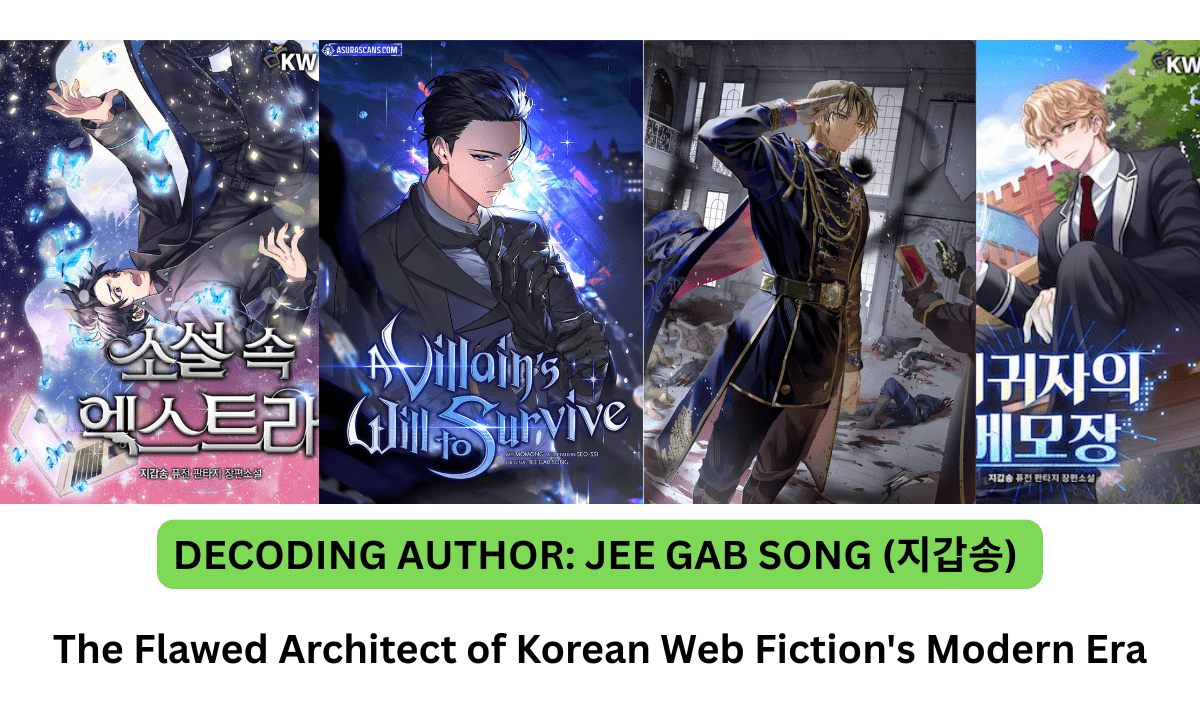
JEE GAB SONG (지갑송): The Flawed Architect of Korean Web Fiction’s Modern Era
Unlock Global Stories with Noyaku!
Tired of waiting? Instantly translate web novels, manhwa, and manhua from their original sources! Noyaku provides Smart AI and Basic translation engines, plus a custom Glossary for consistent terms.
I. Who is Jee Gab Song?
Start with this: nobody knows what he looks like. No interviews, no author photos, no panels. Just the work, uploaded to Munpia, read by millions. For someone who has reshaped an entire genre, that anonymity is almost funny.
Jee Gab Song (지갑송) is probably the most structurally influential Korean web novel author of the 2020s. His 2018 novel The Novel’s Extra, arriving at the same moment as Sing Shong’s Omniscient Reader’s Viewpoint, killed off the decade’s dominant genre formula — the ‘hero kills demon king’ (히전죽) template, and replaced it with something that felt genuinely new: fiction about people trapped inside fiction. The book-isekai (책빙의물) genrethat followed owes its existence largely to him.
That’s the good news. The complicated news is that he can’t seem to finish what he starts. Korean readers have a nickname for him: ‘100화의 지갑송’ — roughly, ‘the guy who’s great for 100 chapters.’ It’s a compliment and an insult at the same time, which is probably accurate.
|
“100화의 지갑송” — The Jee Gab Song of 100 Chapters His novels open with extraordinary precision: sharp character chemistry, tight plotting, meta-fictional setups that pay off beautifully. Then, somewhere past chapter 100, things come apart. Subplots pile up without resolving. Fan pressure bends pre-planned arcs. The coherence he built so carefully starts to dissolve. This pattern is so consistent across his bibliography that Korean readers treat it less as a criticism and more as a fact of life. |
He writes about authors and game developers sucked into their own half-finished creations — stories that have escaped their maker’s control. You can read that as coincidence. I find it hard to.
II. The anonymous craftsman behind nine novels
His previous pen name was 종갓집 (Jongatjip). A Kyobo Bookstore bio from that era described him as ‘a university student living alone somewhere on Earth who writes.’ When he switched to the Jee Gab Song name via Munpia’s one-time pen name change policy, he initially denied the connection. He was eventually exposed through old Kakao Page comment histories — a minor scandal Korean readers refer to as ‘필명세탁’ (pen name laundering). He has not commented on it publicly, because he doesn’t comment on anything publicly.
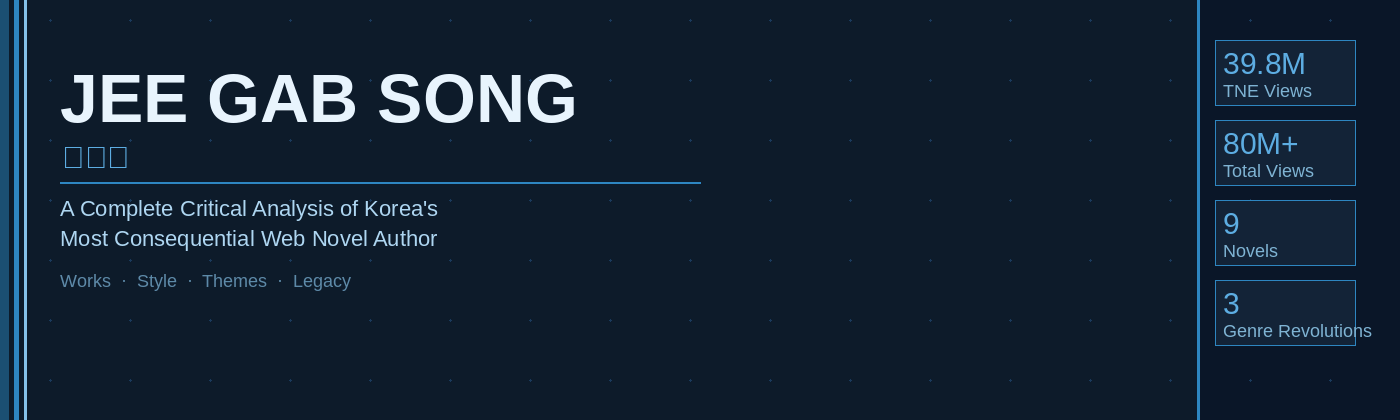
His platform is Munpia. Distribution through Kakao Page, ebooks via KW Books. Never on Naver Series or Novelpia. Kakao Page has at some point called him ‘현재진행형 레전드’ — ‘an ongoing legend.’ Combined view counts across the platform: north of 80 million.
Complete bibliography
|
Work |
Year |
Chapters |
Kakao Views |
Genre |
|
A New Game Begins |
~2016 |
11 vol. |
– |
Game-isekai |
|
Summoner of Another World |
~2016 |
12 vol. |
– |
Fantasy |
|
A Monster Who Levels Up |
2017 |
175 ch. |
– |
Fusion Fantasy |
|
The Producer Who Draws Stars |
2021-22 |
409 ep. |
9.4M |
Modern Fantasy |
|
Memoirs of the Returnee |
2023-24 |
409 ch. |
12.2M |
Fusion Fantasy / Academy |
|
Semi-Coercive Imperialist |
2025-ongoing |
160+ ch. |
Ongoing |
Regression Fantasy |
The starred entries are the ones that matter most for understanding his place in the genre. Five of his six major works have English translations — The Novel’s Extra on Wuxiaworld (complete), Semi-Coercive Imperialist on KJNovels (active).
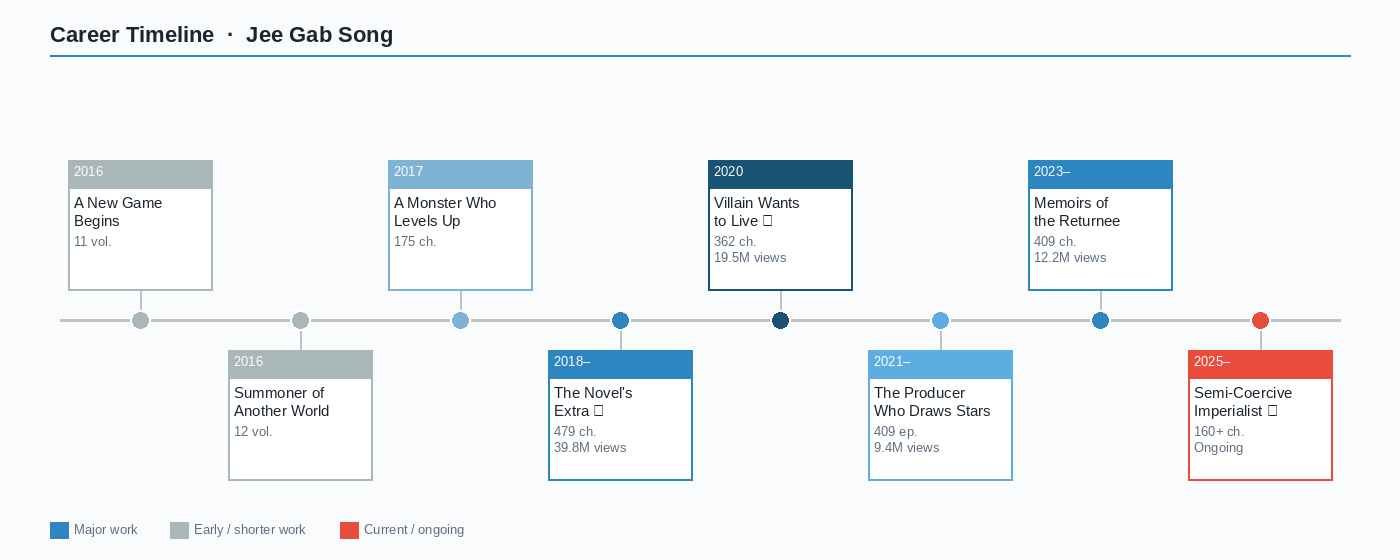
Figure 1 — Career timeline: nine works across roughly a decade
III. How he writes
Korean readers describe his style as having ‘light novel sensibility’ (라노벨적 감성) — a mix of Japanese light novel conventions and Korean web fiction rhythms. What that means in practice: he front-loads relationships, not power systems. Most male-oriented Korean web novels spend their early chapters establishing what the protagonist can do. Jee Gab Song spends his establishing what the protagonist makes the people around him feel.
Dialogue as his main instrument
His real gift is dialogue. Wuxiaworld translators flagged this early: his female characters don’t fall for the protagonist because he saved them, and they don’t behave like idealized accessories. They react to him like specific people who have specific reasons for feeling what they feel.
Korean review communities praised his ability — called ‘극한의 찐따 묘사’ — to render socially awkward protagonists without making them either pathetic or secretly suave. The fumbling comes through. And somehow, it’s compelling.
“목소리 뭐야…” (“What’s with that voice…”) — A single line from The Novel’s Extra. Four characters, including ellipsis. It became one of the most-referenced moments in Korean genre fiction, which tells you something about how much weight he can pack into almost nothing.
He understands silence better than most writers in this genre. His male leads deflect and abbreviate. His female leads read those deflections through their own emotional frameworks and arrive at conclusions that are wrong in ways that are heartbreakingly plausible. The misreadings aren’t stupid — they’re human. That’s the trick.
The pacing problem
Korean readers have measured his quality arc for The Novel’s Extra with the precision of disappointed engineers:
- Cube Academy arc (Ch. 1-50): 4/5 — tight, alive, electric
- Tower arc (Ch. 51-150): 2.5/5 — subplots begin piling up
- Post-tower (Ch. 151-300): 1.5/5 — coherence breaks down
- Side stories: 4/5 — focused, emotionally honest, often his best writing
- Overall: 3/5
The same arc holds for his other major works. Something happens around chapter 100. Fan pressure is part of it — he reportedly rerouted pre-planned story beats in The Novel’s Extra when certain character fandoms got loud enough, and the seams show. It’s the central frustration of following his work: he builds the architecture beautifully, then hands the keys to the crowd. If you want to see where his works fall in the broader landscape, DragneelClub’s complete web novel tier list has some honest takes on both The Novel’s Extra and The Villain Wants to Live.
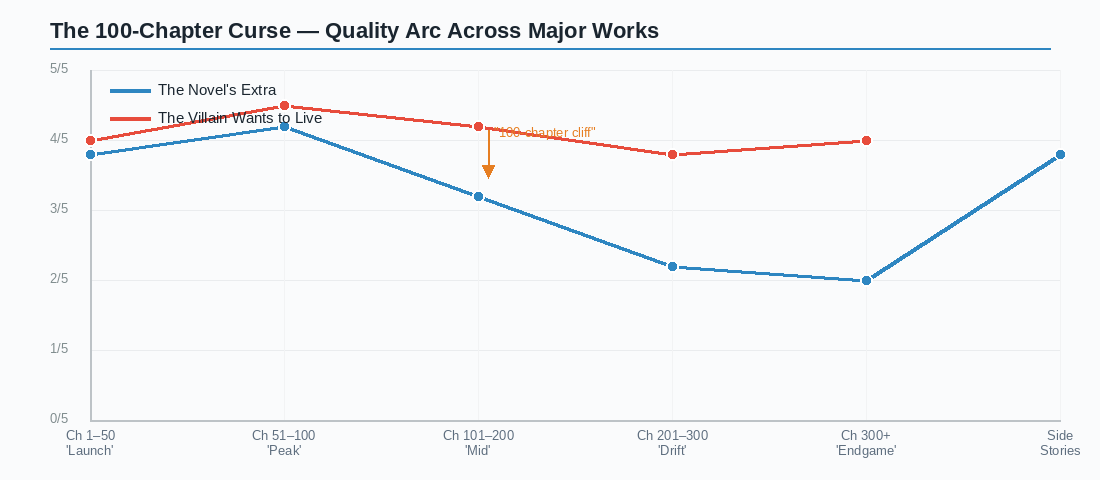
Figure 2 — Quality arc across major works: what readers actually scored
The tonal constant
“The ending is always bittersweet. There was always this self-sacrificing MC in the end and then the women that fall for him would hate him for some reason until they discovered the truth and regretted it.” — Light Novel Cave reviewer
That reviewer is describing a feature, not a bug. He leans into melancholy deliberately. His stories don’t deliver the cathartic harem resolution the genre formula typically promises. The protagonist stays just out of reach. The feelings stay unrequited, or half-realized, or resolved only in alternate-timeline side stories that exist outside the main canon. It’s a choice — not always a satisfying one, but a choice.
IV. The protagonist archetype
Every Jee Gab Song protagonist is a version of the same person: someone who knows more than everyone around them, can’t tell anyone why they know it, and is fundamentally alone because of it. The specific mechanism varies — an author in his own novel, a developer inside his own game, a regressor who’s already lived through the disaster. But the psychology is consistent.
Korean fan communities named this formula ‘지갑송의 4원소’ — Jee Gab Song’s four elements:
|
Jee Gab Song’s four elements (지갑송의 4원소) 1. Game/book-isekai setup — the protagonist inhabits a pre-existing fictional world 2. Growth arc — starts disadvantaged, gets stronger through deliberate effort 3. Information advantage — knows the world’s secrets; can’t reveal them 4. Hidden charisma — female characters are drawn to something they can’t quite name |
The protagonists, one by one
- Kim Hajin (The Novel’s Extra): The author, dropped into his own unfinished novel as a nameless background character. He knows every fate, every plot twist, every dungeon layout. Except a co-author has been rewriting the world without him, and the gaps between what he wrote and what he finds are where the actual story happens.
- Kim Sae-Jin (A Monster Who Levels Up): Wakes up as a monster with no explanation. Has to navigate human society and the monster world simultaneously, neither fully belonging to either. The identity question — what am I, really — is messier here than in later works, and less resolved.
- Kim Woojin / Deculein (The Villain Wants to Live): A game developer reborn as the mid-level boss who dies in 999 out of 1,000 playthroughs. Uses programming logic and game knowledge to stay alive in a world of magic. The gap between who the character was designed to be and who the person inside him actually is — that’s the engine of the whole novel.
For a side-by-side look at how The Villain Wants to Live and Omniscient Reader’s Viewpoint compare to other completed Korean novels, DragneelClub’s top completed web novels list is worth bookmarking.
- Sion (Memoirs of the Returnee): A regressor whose ‘Notepad’ ability records future events as literal written text. The most overtly literary framing in the series — future-knowledge as manuscript.
- The protagonist (Semi-Coercive Imperialist): Regresses after watching an empire collapse. Has to impose a version of civilization that nobody asked for, using methods he finds repugnant, because the alternative is annihilation. His inferiority complex runs deep and the title is a kind of bitter joke about what he’s become.
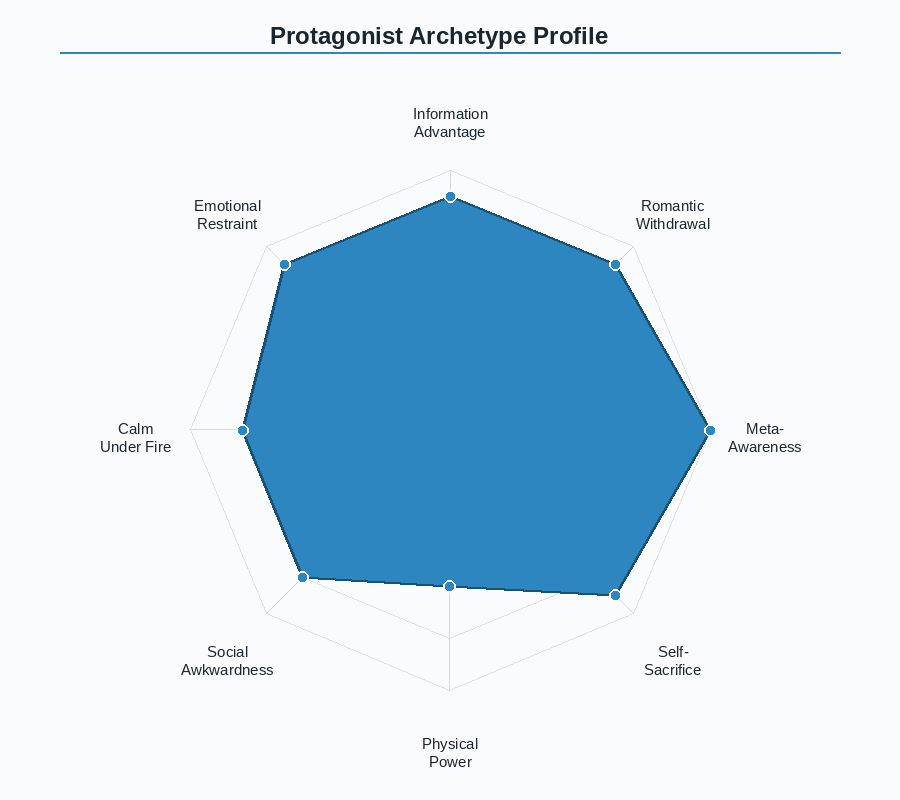
Figure 3 — Protagonist trait distribution across works
Not heroes — calculators
None of these people are hot-blooded. They don’t charge into fights on impulse. They calculate, they wait, they act when the math works out. Fans tag them as ‘Calm Protagonist,’ ‘Antihero Protagonist,’ ‘Hated Protagonist,’ ‘Introverted Protagonist’ — and all four labels are accurate, all the time. The emotional restraint reads as coldness to the people around them. Which is, of course, the engine of most of the misunderstandings.
Knowing the ending isn’t the same as escaping it
Every one of these protagonists carries a specific dread: they know, roughly, how the story is supposed to end, and that ending is usually bad for them personally. The villain dies. The extra gets forgotten. The regressor has already seen the catastrophe. Watching them fight not just enemies but the logic of the narrative they’re trapped in gives the stories a weight that straight power fantasy doesn’t have. They’re not just getting stronger — they’re trying to stay alive in a story that has already decided what they’re for.
V. The women, the tension, and the non-resolution
His heroines are the best thing about his work and the source of his most reliable frustration. He builds them with real care — specific psychologies, genuine motives, histories that exist independent of the male lead. They’re not there to be impressed by the protagonist. They have things they want, things they’re afraid of, and reasons that are entirely their own for why he gets under their skin. If you enjoy the villain-protagonist dynamic in Korean fiction more broadly, the best Korean villainess novels list covers several works with similar emotional DNA.
Who they are
- Chae Nayun (The Novel’s Extra): Volatile and grief-driven. Her hostility toward Kim Hajin is grounded in a genuine misunderstanding with real tragic roots. Her arc is the most emotionally complex in the series — and the one that most rewards rereading, because the reasons for her behavior are visible from early on if you know where to look.
- Yoo Yeonha (The Novel’s Extra): Calculating, politically sharp, ambitious in ways she’s learned to camouflage. Her interest in Kim Hajin starts when she recognizes something in his competence that mirrors her own.
- Rachel (The Novel’s Extra): Composed, careful, carrying the story’s best sense of unrealized potential. Her dedicated side-story epilogue is one of his finest pieces of writing.
- Epherene (The Villain Wants to Live): Clumsy, brilliant, funnier than she means to be. Her relationship with Deculein/Woojin is the emotional core of the novel — the place where the story’s themes about sacrifice and misunderstanding land with the most force.
- Sophien (The Villain Wants to Live): The Emperor. Arrogant, powerful, and almost entirely wrong about Deculein for most of the novel. Her arc from threat to grief is where the book’s final emotional weight lives.
And then — after all that care — he refuses to resolve any of it. The protagonist stays distant. The feelings stay suspended. The side stories split into heroine-specific alternate endings because the main story structurally cannot choose, so it multiplies instead.
“He likes to play with the feelings of the female love interest, but likes to keep the male lead out of their reach.” — Novel Updates Forum, 2018 thread titled “Sick Hobby of Jee Gab Song”
That forum thread is worth reading, not because the criticism is wrong, but because the response to it is interesting. Most readers in the thread agreed with the diagnosis and then said they’d keep reading anyway. Which is the honest relationship most of his fans have with this particular habit: it’s annoying, it’s deliberate, and it somehow doesn’t stop working.
Whether the refusal to close the romantic loop is artistic restraint or a way of keeping readers hooked is a question I keep landing on different sides of, depending on the work.
VI. How he builds worlds
He doesn’t invent settings wholesale. His method is to take something readers already recognize — the hunter academy, the magic empire, the modern guild system — and add one layer of meta-fictional awareness on top. The world is already someone’s novel. Already someone’s game. The protagonist’s relationship to that pre-existing architecture is where all the interesting material lives.
This makes his worlds feel immediately readable. A first-time reader of The Novel’s Extra doesn’t need the academy genre explained. But the way Kim Hajin moves through that academy — with foreknowledge he can’t reveal, in a body that isn’t quite his — turns familiar furniture into something stranger.
The Novel’s Extra — two layers at once
Cube Academy is standard hero-training genre material on the surface. Under it: Kim Hajin built this place, knows every character’s trajectory, knows which dungeons are death traps and which fights his body can’t win. He should have total control. Except a co-author has been rewriting the world around him, raising difficulty levels, introducing variables he didn’t design. The gap between the novel he wrote and the world he’s living in is the story’s actual engine. Every surprise comes from that gap.
The Villain Wants to Live — his most rigorous world
This is where his world-building gets genuinely impressive. Full high fantasy — Western-style magic empire, an academy, aristocratic politics — and he treated the magic system like an engineer would. Not just ‘here’s what spells do’ but formulas for spell construction, density calculations for magical saturation in a given area, historical debates among fictional elder mages. Most of that specificity doesn’t matter for understanding the plot. But it makes the world feel like it predates the reader’s arrival, which is the hardest thing to fake.
“Even knowing those influences, I gave it 5 stars because the author blended them so deliciously.” — Ridibooks reviewer, comparing Deculein’s arc to Code Geass’s Zero Requiem and Steins;Gate
Semi-Coercive Imperialist — the darkest version
His current work is his most politically ambitious setting. A feudal empire with active racial discrimination, class stratification, and a rebellion that has legitimate grievances. Less about surviving a story someone else designed, more about the ethics of forcing civilization on people who didn’t ask for it. Heavier than his previous work. Harder to read. Probably his most mature world yet, though whether he’ll sustain it past chapter 200 is the question everyone who’s been following him for years is holding their breath about.
Power systems
- The Novel’s Extra: marksmanship plus stat-grinding plus craftable weapons. An unglamorous kit that forces tactical thinking rather than raw power. He chose the most boring-sounding ability on purpose, and it works. For context on how this fits into the broader system/leveling novel genre, it’s a notably restrained choice.
- The Villain Wants to Live: magic as engineering discipline. Formulas, density calculations, historical theory. Power escalation feels earned because the rules are consistent enough to feel real.
- Semi-Coercive Imperialist: sword mastery within a knight hierarchy. Power is institutional here — you are as strong as the system you’re operating within allows, until you’re not.
VII. What the stories are actually about
1. Fiction and reality are not as separate as advertised
A 2023 academic paper by Hong Woojin and Shin Horim in the journal International Language & Literature (국제어문) ran The Novel’s Extra through possible-worlds theory and found something they found genuinely surprising. When Kim Hajin builds a real self inside his own fictional creation, he dismantles the hierarchy between ‘real’ and ‘possible’ worlds. The world he wrote stops being subordinate to the world he came from. It has its own reality. Its people have their own interiority.
This isn’t just a clever structural device. It’s a claim about what fiction is — that the line between created worlds and real ones is softer than we want to believe. His protagonists don’t escape back to reality. They become real where they are.
2. Fighting the story you were cast in
Can you rewrite a destiny that was already written down? That question runs through everything he’s published. The villain is supposed to die. The extra is supposed to stay peripheral. The regressor has already watched the ending. Every one of his protagonists is trying to refuse the role they were handed — not through some dramatic declaration, but through the grinding daily work of staying alive one chapter longer than the narrative intended. The regression theme is common in Korean web fiction, but few authors use it with this much psychological weight — A Regressor’s Tale of Cultivation is one of the few that gets close.
3. Self-sacrifice as the recurring answer
His protagonists keep arriving at the same conclusion: the only way through is to let the world take something from you. In The Novel’s Extra it shows up at the end. In The Villain Wants to Live it becomes the dominant mode from about halfway through. Multiple Korean reviewers compared Deculein’s arc to Code Geass’s Zero Requiem — concentrate all the world’s hatred on yourself, then disappear — and to Steins;Gate’s logic of necessary deception. Both comparisons hold. The irony embedded in the title ‘The Villain Wants to Live’ is that by the end, he has essentially stopped trying.
4. Being an ‘extra’ as a social feeling
Scholar Yu In-hyeok’s 2020 paper in the Journal of Popular Narrative (대중서사연구) made a point that’s been cited a lot since: when a marginal character (the extra, the villain, the background NPC) outpaces the original protagonist, that’s not just a genre twist. It maps directly onto what a generation of Korean readers recognizes from their own lives.
“Readers no longer prefer extraordinary heroes; they respond more actively to success stories of ordinary people. In fundamentally hostile environments, the only path to success for the marginalized is obtaining miraculous opportunity.” — Yu In-hyeok, Journal of Popular Narrative, 2020
The information advantage that Jee Gab Song gives his protagonists isn’t just a plot mechanism. It’s wish fulfillment for people who feel like they’re playing someone else’s game, on someone else’s terms, without the foreknowledge that might make it fair.
5. Things that almost happen
Love that stops one scene short of becoming anything. Relationships that orbit each other for 200 chapters and never quite land. Goals achieved at a cost that makes the achievement feel hollow. He’s drawn to the texture of unfulfillment in a way that’s rare in this genre. Most web novel authors find the payoff. He finds the moment just before the payoff and stays there.
<br>
VIII. What he built that others live inside
His contribution to Korean web fiction isn’t one great novel. It’s a set of structural templates that became so widely adopted that most readers consuming academy fiction or book-isekai today are working within frameworks he established, often without knowing his name.
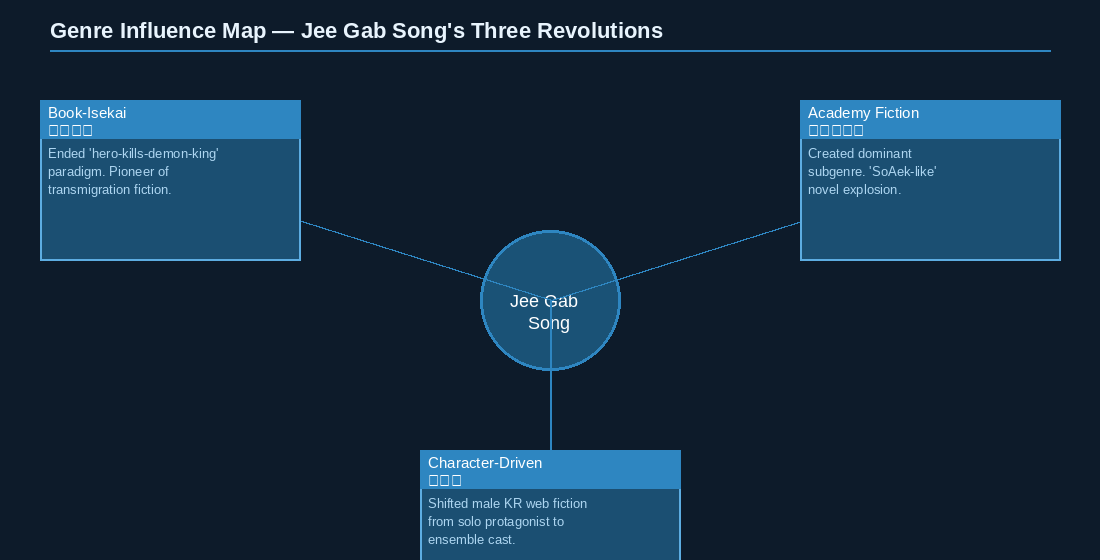
Figure 4 — Genre influence map: three shifts in Korean web fiction
The book-isekai genre (책빙의물)
The Novel’s Extra, alongside Omniscient Reader’s Viewpoint and The Youngest Son of a Count’s Family, made transmigration into existing fictional worlds the genre’s dominant template. It displaced the previous defaults — original-world isekai, death-and-reincarnation setups — within a few years. The template spread fast because it solved a specific creative problem: how do you give a protagonist foreknowledge without making the story trivially easy? His answer was to make the foreknowledge incomplete and contested.
The blueprint is visible across dozens of descendants — Trash of the Count’s Family being one of the clearest examples of the formula applied to a different emotional register. DragneelClub has a full breakdown of what happened with Trash of the Count’s Family’s translation, which is worth reading as a case study in how licensing disputes affect this corner of publishing.
The academy genre (아카데미물)
Academy settings existed before The Novel’s Extra. After it, they became the genre’s default environment. The word ‘소엑라이크’ (SoAek-like) was coined specifically to describe novels copying his formula: a meta-aware protagonist in a hero-training academy, emphasis on character dynamics over combat. The Villain Wants to Live pushed this further by making the protagonist a professor rather than a student, which spawned its own sub-trend of teacher-academy stories. The academy’s hunter/gate format is shared with manhwa like those covered in DragneelClub’s best manhwa like Solo Leveling — though Jee Gab Song takes that raw material in a very different tonal direction.
Character-driven storytelling (캐빨물)
Before his work, male-oriented Korean web fiction tended toward single-protagonist dominance, supporting characters existed to react to the hero. He built ensemble casts where heroines have internal lives, independent arcs, and reasons to matter that exist outside their relationship to the protagonist. Namu Wiki credits this shift as a factor in the rise of Novelpia in the 2020s, as new authors who’d grown up reading his work iterated on the formula.
IX. Reader reception and the webtoon disaster
The pattern of his readership is: fall hard for the first hundred chapters, get increasingly frustrated by chapter 200, complain loudly on DC Inside and Etoland, and keep reading. The Novel’s Extra hit 22.5 million views on Munpia with 682,000 recommendations. The Villain Wants to Live: 16.1 million views, 57,000 favorites. These are not numbers produced by passive audiences.
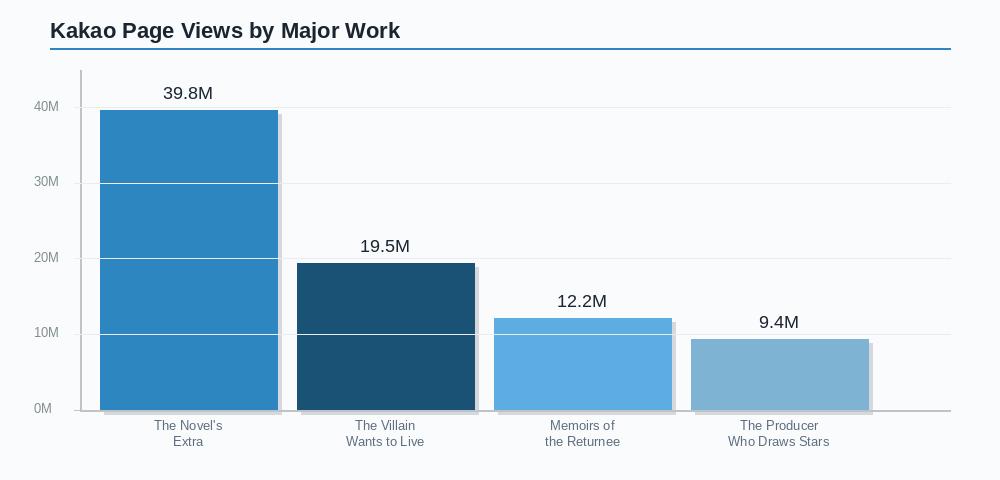
Figure 5 — Kakao Page views by major work
Goodreads ratings sit around 3.9-4.2 for individual volumes, pulled down by endings that divided readers. The international audience found him through Wuxiaworld’s licensed The Novel’s Extra translation — 87% positive rate across 88 reviews, as of the time of this writing. No dedicated Reddit communities have formed around his work, which reflects where his real readership lives: Korean platforms, Korean conversations.
The webtoon that had to be refunded
|
The first adaptation: what went wrong The first Novel’s Extra manhwa, drawn by Carrot Studio, received ratings of 1.8 to 1.9 stars on Kakao Page. It was pulled on July 27 — not just cancelled, but removed with full refunds to all purchasers. Readers accused the artist of tracing panels from One Punch Man. The artist’s social media accounts went down shortly after. Jee Gab Song issued no public statement and had apparently done no promotion for the adaptation. Both are consistent with how he operates. |
The second attempt went better. A remade webtoon achieved a 9.9-star rating with 31.3 million views on Kakao Page — a complete reversal. The Villain Wants to Live adaptation followed, landing 4 million views and a 9.9 rating as well. A French translation of The Novel’s Extra webtoon has been released across at least seven volumes.
X. How he compares to his peers
vs. Sing Shong (Omniscient Reader’s Viewpoint)
Both launched on Munpia in early 2018. Both use the ‘entering a fiction’ premise. Beyond that, the comparison gets interesting because the two writers are doing fundamentally different things with the same starting point.
|
|
Jee Gab Song |
Sing Shong (ORV) |
|
Meta premise |
Author trapped in his own creation |
Reader trapped in someone else’s story |
|
Protagonist |
Everyman loner, emotionally guarded |
Philosophically complex, emotionally raw |
|
Tone |
Bittersweet melancholy, genre-grounded |
Tragic grandeur, literary ambition |
|
Influence |
Genre grammar — templates and formulas |
Single towering cultural phenomenon |
|
Adaptation |
Webtoon (9.9-star remake), French release |
Movie (2025), anime, global “Big 3” status |
|
Protagonist poll |
Kim Hajin — 37% (‘more relatable’) |
Kim Dokja — 63% (‘more human’) |
ORV won — bigger internationally, a 2025 movie adaptation, anime, ranking alongside Lord of the Mysteries and Reverend Insanity in global ‘Big 3’ web novel conversations. Jee Gab Song’s influence runs deeper in the industry’s infrastructure.
A 2018 Novel Updates forum poll asked readers which protagonist they preferred: Kim Dokja (ORV) won 63% to Kim Hajin’s 37%. The characterizations readers gave were ‘more relatable’ for Hajin and ‘more human’ for Dokja. That gap is real, and it’s the gap between Jee Gab Song’s archetype and Sing Shong’s.
International context
Outside Korea, he sits closest to the chuuni Japanese light novel tradition, academy settings, power systems, harem-adjacent character dynamics. The most direct comparisons are Kinugasa Shogo (Classroom of the Elite) and Kamachi Kazuma (A Certain Magical Index). What separates him is his willingness to hurt his protagonist over an extended period. The ‘피폐 전개’ (suffering arc) tradition in Korean web fiction runs darker than most Japanese academy fiction goes, and he leans into it.
For a deep dive into what makes an antihero protagonist truly work at a psychological level, DragneelClub’s character analysis of Fang Yuan from Reverend Insanity is an interesting read alongside this analysis, the contrast with Jee Gab Song’s more empathetic antiheroes is striking.
XI. What he does well and where he falls apart
What works
- Structural foreshadowing: His best writing plants clues so naturally that readers miss them on first pass. On rereads, they’re there — specific details, throwaway lines, moments that only register in retrospect. That’s deliberate craftsmanship, not accident.
- Scene chemistry: Put two of his characters in a room and something happens. The tension is there whether they’re adversaries, potential lovers, or cautious allies. He understands how emotionally complicated people talk around what they actually mean.
- Depth beneath genre: His work has attracted two serious academic papers. That doesn’t happen to web novels that are only doing genre service. The philosophical content in the possible-worlds analysis and the class-mobility reading both emerge from real material in the text.
- Technical world-building: Particularly in The Villain Wants to Live, the magic system feels systematic enough to test. That kind of rigor makes the world feel pre-existing rather than built-to-order.
- The opening hundred chapters: When things are fresh — when the architecture is new and the characters are still surprising each other — he produces something genuinely rare in the genre: people who feel like people, in a world that feels like it was there before you arrived.
Where it breaks down
- The 100-chapter ceiling: It’s not a coincidence. Something structural gives way in the second half of every major work. Subplots that don’t resolve. Tonal lurches. Story beats that feel like they were revised in response to comments rather than planned. The cause seems to be his susceptibility to fan pressure, which bends his pre-planned arcs in ways that damage the overall structure.
- Romantic repetition: The misunderstanding-driven multi-heroine setup is effective the first time you encounter it. By the third novel with the same dynamic, the beats are predictable — the moment the misunderstanding is established, the reader already knows how long it will run and how it won’t be resolved.
- Combat tension: His protagonists are too well-resourced. They always have a contingency. Fight scenes that should carry genuine threat lose it because the reader has learned that the calculation will work out. This is a consequence of the ‘cool and calm’ archetype, and it costs something in the action sequences.
XII. How he has changed across nine works
A Monster Who Levels Up (2017)
His debut. The premise is good, a man waking as a monster, trying to recover his humanity while becoming more capable in his current form, but the execution is lighter than what came after. The meta-awareness is there but implicit. It reads as a writer finding the template rather than deploying it with confidence.
The Novel’s Extra (2018-2020) — 39.8M views
His breakthrough and the work most people start with. The meta-fictional setup is more explicit and more generative here than anywhere else in his catalog. Kim Hajin as both author and character, creator and creation, gives the story a recursive quality that the early arcs exploit beautifully. The sustained misunderstanding between Hajin and every character around him creates dramatic irony that carries 150 chapters easily. Then the Tower arc. Then the drift. The side stories salvage a lot of what the main story loses, and the heroine-specific epilogues are among his best writing. But the overall arc is uneven in ways that are hard to ignore.
The Villain Wants to Live (2020-2022) — 19.5M views
His best novel, by most measures. Richer world-building, tighter structural foreshadowing, a protagonist whose moral complexity is genuinely worked through rather than gestured at. The self-sacrifice arc earns the emotional weight it lands with. The professor-student dynamic gives the character relationships a different register than The Novel’s Extra’s peer dynamics.
Deculein/Woojin is his most interesting protagonist, a person whose game-developer pragmatism keeps colliding with the emotional reality of the world he’s living in. DragneelClub’s 2021 web novel roundup covers the villain-transmigration wave this novel was part of useful context for placing it in the genre moment it arrived in.
Memoirs of the Returnee (2023-2024) — 12.2M views
The ‘Notepad’ mechanic, future-knowledge recorded as literal written text, is his most literary framing to date. 12.2 million Kakao views suggests the readership stayed with him through the gap after The Villain Wants to Live. Less internationally visible than his earlier work, partly because it arrived after the international translation pipeline had slowed.
DragneelClub’s best web novels of 2023 gives some sense of the competitive field it entered.
Semi-Coercive Imperialist (2025-ongoing)
Darker than anything he’s done before. The imperial setting with its active racial discrimination and class stratification gives the story political weight that his previous work approached but never quite committed to. The protagonist’s inferiority complex and his moral disgust at his own methods read as a writer deliberately complicating the archetype he built. 5.0 rating from early readers, 160 chapters as of April 2026. Whether this one holds past the 200-chapter mark is the question. I’d put the odds at better than even, because the premise doesn’t give him the same out, there’s no ‘well, the story just got complicated’ excuse when the complication is built into the premise from chapter one.
XIII. What to make of him
He probably didn’t write the best Korean web novel. That argument goes to Omniscient Reader’s Viewpoint, or maybe something else depending on who you ask. What he did was build the grammar that most of the genre speaks now. The academy setting, the meta-fictional layer, the ensemble cast with real heroines, these are default assumptions of 2020s Korean web fiction, and he’s why.
The paradox that defines his career is too neat to ignore: he writes about authors and developers who enter their own creations only to lose control of them. His stories keep escaping from him. He builds something careful and then fan pressure, or boredom, or some failure of execution takes it somewhere he didn’t plan. His protagonists fight narrative fate. He keeps losing to it.
But the opening hundred chapters, consistently, across nine novels, are something worth reading. Not ‘good for web fiction’ good. Just good. Characters who feel like they have weight. Worlds that feel like they preexist the story. Dialogue that does more work in four characters than most authors manage in four pages.
That’s enough to explain a decade of frustrated loyalty. He keeps building things that are worth following into the second half, even knowing what the second half usually does.
If you’re new to his work, the best starting point is The Novel’s Extra — imperfect as it is. If you want a sense of where his novels sit among the broader Korean web novel landscape, DragneelClub’s best 10 Korean web novels list and the top 184 completed web novelsare good places to triangulate.
His stories consistently escape his grasp. But those first hundred chapters, when the architecture is fresh and the characters are finding each other, that is where a reader encounters something genuinely rare in web fiction: characters who feel like people, navigating worlds that feel like mirrors.
Sources and references
Namu Wiki (나무위키): entries for 지갑송, 소설 속 엑스트라, 악당은 살고 싶다, 반강제적 제국주의자
Hong Woojin and Shin Horim. ‘Possible-Worlds Theory in The Novel’s Extra.’ International Language & Literature (국제어문), 2023.
Yu In-hyeok. ‘Class Mobility and the Book-Isekai Genre.’ Journal of Popular Narrative (대중서사연구), 2020.
Munpia serialization data: novel.munpia.com/112155 (TNE), novel.munpia.com/236702 (VWtL)
Kakao Page author exhibition, combined view counts and author marketing materials
Wuxiaworld review data: wuxiaworld.com/novel/the-novels-extra
Novel Updates Forum community discussions, DC Inside 장르소설 gallery, Ridibooks reader reviews, Light Novel Cave reviews